About the Author
To those who seek freedom
The Aquarian Age is dawning, and its influence will gradually free men from the bondages of mind and spirit which they have suffered for thousands of years. Elsa M. Glover's The Aquarian Age foretells of these sweeping changes to come, offering hope and assurance that the freed mind and spirit will soar to yet undreamed-of heights.
Dr. Glover explains how, during the Piscean Age, man's ignorance of his potential kept him from developing his creative abilities, man's lack of self-esteem kept him dependent on others for approval, and man's fear of the unknown kept him from wanting to explore new ideas or even associate with anyone who might have a different perspective on life than his own.
Dr. Glover shows how the Aquarian Age will, however, help people to break out of the shell of ignorance, lack of self-esteem, and fear so that they can become, for the first time in history, truly free. As people become free to explore their own inner natures, the world around them, and other peoples, unprecedented advances will be made in self-actualization, scientific understanding and invention, and universal love.
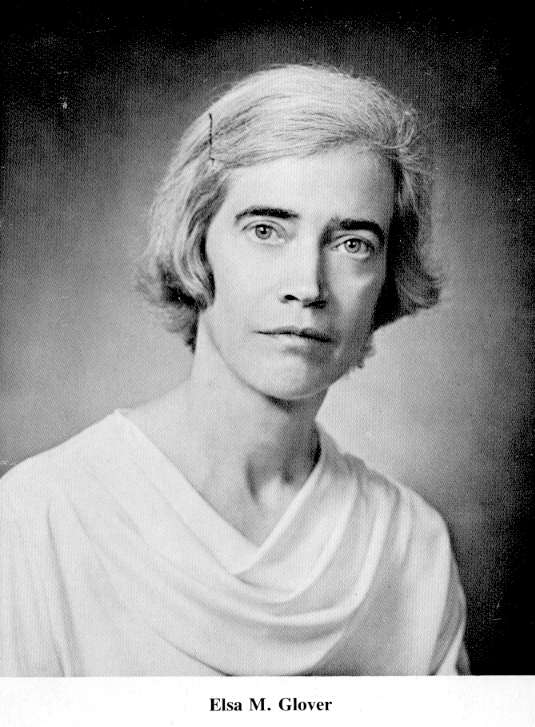
About the Author
Elsa M. Glover graduated from the University of Rochester with a bachelor of science degree in physics and went on to study at Purdue University. She graduated from Purdue with both a master's degree and a Ph.D. in physics, and she is currently a professor of physics at Stillman College. Ms. Glover has also studied scientific astrology and Christian mysticism for many years. The author has written and lectured widely on such subjects as science and religion, astrodiagnosis and Aquarian conflict resolution.
I. The Nature of Astrological Influences
II. The Aquarian Age
III. Aquarian Value Systems
IV. The Aquarian View of Self
V. Laws versus Freedom
VI. Copying versus Exploring
VII. Personal Initiative in the Aquarian Age
VIII. Creativity
IX. Resonance
X. Universal Friendship
XI. Science and Religion in the Aquarian Age
XII. Etheric Vision
XIII. Aquarian Conflict Resolution
XIV. Aquarian Methods of Teaching
XV. Aquarian Government
XVI. Aquarian Age Politics
XVII. Justice in the Aquarian Age
XVIII. Aquarian Methods of Healing
XIX. Aquarian Mental Exercises
XX. Self-Control in the Aquarian Age
XXI. Aquarian Age Allegories
God is Light...If we walk in the Light as He is in the Light, we have fellowship with one another. --I John 1:5-7
"There is one glory of the sun, and another glory of the moon, and another glory of the stars; for star differs from star in glory." --I Corinthians 15:41
When we speak or sing, we generate sound waves, which travel out in all directions from our bodies and can influence others if they listen. Our bodies generate heat and radiate heat out into the surrounding air or nearby objects and thereby warm them. Our bodies also generate finer types of waves [etheric waves, emotional waves, and thought waves] which can travel outward from our bodies and can influence others around us if they "attune" themselves. The nature of the etheric, feeling, and thought waves which we radiate depends on the nature of our character. If we are greedy, we radiate greed. If we are generous, we radiate generosity. If we are loving, we radiate love.
The Sun, the planets that orbit the Sun, and the moons that orbit the planets are the bodies of exalted spiritual beings. Just as we through our bodies, radiate various waves, so also do these spiritual beings generate and radiate waves of various types. Just as the nature of the waves that we radiate depends on the nature of our personality, so also does the nature of the radiations of the Sun, planets, and moons depend on the nature of the beings working in these bodies. It is observed by astrologers that the planets radiate waves that tend to stimulate the following aspects in man: [Astrologers usually shorten the phrase "Sun, Moon and planets to "planets", although the Sun and Moon are still understood to be included.]
|
Planets: |
Qualities Stimulated: |
|
Sun |
Self-direction, use of will power |
|
Mercury |
Logical thought, self-expression |
|
Venus |
Harmony, beauty, personal love |
|
Moon |
Memory, imagination |
|
Mars |
Desire |
|
Jupiter |
Devotion, giving of self |
|
Saturn |
Retrospection, forethought, persistence |
|
Uranus |
Outreach, altruism, exploration, independence, creativity |
|
Neptune |
Intuition |
|
Pluto |
Regeneration, forgiveness, reform |
Just as the angles of the Sun's rays determine whether the Earth will experience summer or winter, so also the angles at which the various planetary rays strike the Earth affect the nature of the influence of the planetary radiations. In order to determine the angles and the effects of the different angles, the sky as viewed from the position of a person on Earth is divided into twelve sections, called houses, and the path traveled by the Sun is divided into twelve sections, called signs of the Zodiac. The first house has its beginning at the Eastern horizion. The first sign [Aries] has its beginning at the point in the sky where the Sun is at the beginning of spring.
Astrologers observe that the house a planet is in determines the area of life into which the planetary radiations tend to be focused.
|
House Number: |
Area of Life: |
|
1 |
Personality |
|
2 |
Material Possessions |
|
3 |
Concrete Thought |
|
4 |
Home |
|
5 |
Leadership |
|
6 |
Service |
|
7 |
Partnership |
|
8 |
Desires |
|
9 |
Abstract Thought |
|
10 |
Fame |
|
11 |
Friends |
|
12 |
Isolation |
Astrologers observe that the sign a planet is in determines the part of the human body on which the planetary rays will be focused and the level of being or consciousness on which the rays will be focused.
|
Sign: |
Part of the Human Body: |
Level of Being: |
|
Aries |
Upper part of the head |
Fire--Cardinal |
|
Taurus |
Lower jaw, neck |
Earth--Fixed |
|
Gemini |
Arms, lungs |
Air--Common |
|
Cancer |
Stomach |
Water--Cardinal |
|
Leo |
Heart |
Fire--Fixed |
|
Virgo |
Intestines |
Earth-Common |
|
Libra |
Kidneys |
Air--Cardinal |
|
Scorpio |
Genitals |
Water--Fixed |
|
Sagittarius |
Hips, thighs |
Fire--Common |
|
Capricorn |
Knees |
Earth--Cardinal |
|
Aquarius |
Ankles |
Air--Fixed |
|
Pisces |
Feet |
Water--Common |
The cardinal signs stimulate activity in the physical body; the fixed signs stimulate persistence in the desire nature; the common signs stimulate investigation with the mind. The fire signs focus the consciousness on the vitality; the earth signs focus the consciousness on the mind; the water signs focus the consciousness on the feelings.
When a child is born, the exact moment it draws its first breath is taken as the time on which the natal horoscope is based. The reason for this is that this first breath of air carries with it the vibratory patterns in the atmosphere at that time. These vibratory patterns are carried from the lungs to the blood and thence to every part of the body, and they set every atom in the body into a like pattern of vibration. Thus the body is attuned to the astrological pattern of vibration present at the time when the first breath was drawn. This attunement remains throughout life. As the planets move through the sky throughout the person's life, they tend to stimulate one part or another of the natal vibratory pattern. The person then may feel an impulse or an energy within himself which makes him want to do something [what thing it is depends on the specific planets involved and their angles].
One of the aims of evolution is to become fully capable of responding to the impulses from all the planets. All of our energies come from the planets and stars and, only insofar as we are capable of receiving them are they available for our use.
Another aim of evolution is to gain conscious control over which energies we will use. Just because we have the energy needed to do something does not mean it is appropriate to do that thing. Not all energies blend harmoniously together. We need to learn when and how to use the available energies and when to let them pass right through us.
References
-Heindel, Max, Message of the Stars, Oceanside, California: The Rosicrucian Fellowship, 1973
-Heindel, Max, Simplified Scientific Astrology, Oceanside, California: The Rosicrucian Fellowship, 1962
Every human being bears a higher man within himself besides what we may call the work-a-day man. This higher man remains hidden until he is awakened. And each human being can himself alone awaken this higher being within himself." --Rudolf Steiner "Knowledge of the Higher Worlds
The Earth rotates on its axis, making a complete turn every twenty-four hours. As the Earth turns its different sides toward the Sun, life on Earth alternately experiences day and night. Creatures on Earth adjust the timing of their activities so that during the day they do those things which are facilitated by light and warmth, and during the night they do those things which are suited to dark and cool conditions.
Suppose we view the solar system from a spaceship, which flies in such a way that to it the center of the Earth appears to be at rest. When viewed from the spaceship, the Sun will appear to travel approximately in a circle around the Earth. The Sun's path is tilted so that part pf it lies above the plane of the Earth's equator [see figure 1]. When the Sun is on the part of its path above the equatorial plane [from March 21 to September 21], the days in the Northern Hemispher are longer than the nights and the spring and summer seasons are experienced. When the Sun is on the part of its path below the equatorial plane [from September 21 to March 21], the days in the Northern hemisphere are shorter than the nights, and the fall and winter seasons are experienced. Life on Earth adjusts its activities to the changing seasons, using the spring and summer for procreation and growth, and using the fall and winter for harvesting and hibernating.
The time when the Sun's path crosses the plane of the Earth's equator going northward [about march 21] is called the spring equinox. Starting from the position of the sun at the spring equinox, the Sun's path is divided into twelve sections, called signs of the Zodiac.
Just as the atom appears to have structure similar to that of the solar system, so also does this twelve-sectioned structure appear at various levels within the universe. The human body is divisible into twelve parts, each having a particular sensitivity to the solar radiations when they come from the corresponding part of the Sun's path. Beyond the twelve parts of the human body and twelve parts of the Sun's path [signs of the Zodiac] are twelve patterns of fixed stars [which are called constellations].
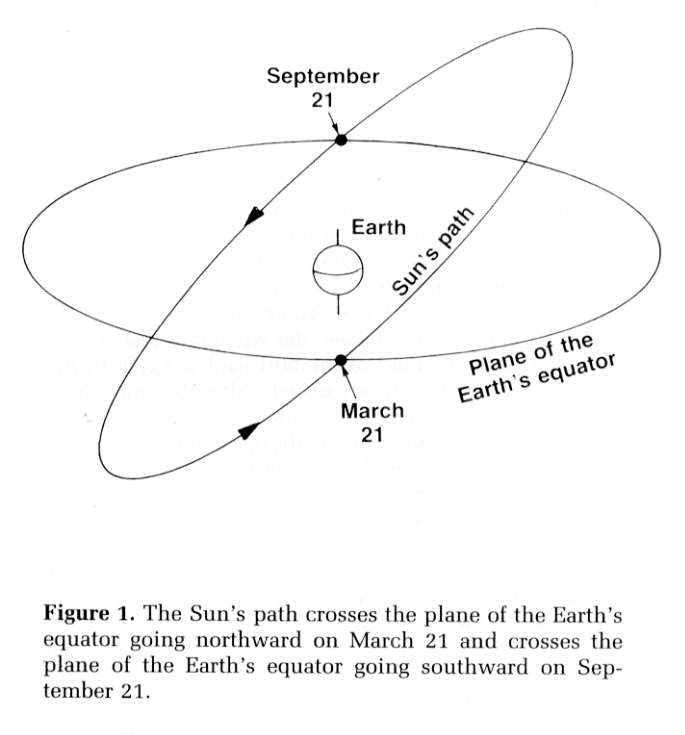
Due to a slow wobbling motion of the axis of rotation of the Earth, the plane of the Earth's equator slowly changes its orientation. This causes the spring equinox to change its position relative to the constellations. Viewed from the Earth, the spring equinox occured in the constellation of Taurus between about 3700 B.C. and 1600 B.C. The Earth was then said to be in the Taurean Age, and worship of the bull was prominent in various religions. At the spring equinox, everything on Earth is impregnated with life, so that when the spring equinox was in the constellation of Taurus, the sun was focusing a Taurean influence into all plants and creatures on Earth at the time of their rejuvenation each spring.
The spring equinox occurred in the constellation of Aries between about 1600 B.C. and A.D. 498. Then the lamb began to be worshiped. The blood of the lamb was used to protect the original Semites when they were trying to escape from the land of the bull [called Egypt in the biblical account]. Christ called himself the Good Shepherd.
The spring equinox entered the constellation of Pisces around A.D. 498 and will continue to be in Pisces until around A.D. 2638. Christ called his disciples to be "fishers of men" and the Bishop's miter is in the form of a fish's head.
The spring equinox will be in the constellation of Aquarius from about A.D. 2638 to A.D. 4700.
Because the spring equinox has not yet reached the constellation of Aquarius, the question may be raised as to why we should at the present time bother thinking about the Aquarian Age. One reason for looking ahead is that it is good to keep in mind what one is aiming at so that one can move directly toward the goal. Another reason is that although the equinox does not enter the constellation of Aquarius until A.D. 2638, the Sun focuses the influences coming not just coming from a point, but from a band in the sky [which is broader than the physical boundaries of the Sun]. Already this band of influence of the Sun is touching the constellation of Aquarius. Thus, even now, the Aquarian influence is beginning to be felt by some people. Another reason is that among the millions of people in the School of Life on Earth, there are some who are sufficiently precocious that they are able to move forward faster than others and are thus ready to move into a new age prior to the time scheduled for humanity as a whole [just as some may need to remain in an old age after most of the rest of humanity has moved out of it].
In nature there are cycles within cycles. In the day-night cycle, it tends to be warmer during the day and cooler at night. In the summer-winter cycle, it tends to be warmer in the summer and cooler in the winter. With the summer-winter cycle superimposed in the day-night cycle, summer days will tend to be warmer than winter days, and summer nights will tend to be warmer than winter nights. Similarly, during an age, the characteristics of that age become superimposed on all the smaller cycles within the age. In the Piscean Age, the Sun still travels through the twelve signs of the Zodiac each year, bringing influences from each, but a Piscean influence is superimposed over all. In the Aquarian Age, the sun still travels through the twelve signs of the Zodiac each year, bringing influences from each, but an Aquarian influence will be superimposed over all.
Astrologers have observed that a Piscean influence stimulates people to respect authority, to believe what authorities tell them to do, and to obey laws laid down by authorities. The ones set up as Piscean "authorities" may attain their positions by heredity [kings or other "well-born" or "high-class" individuals] or by the exercise of physical power [military leaders, dictators] or by some divine dispensation [priests, clergy]. Traditions and customs are also set up as "authorities" and are used as guides for actions.
An Aquarian influence, on the other hand, stimulates people to wish to break away from tradition and authoritative rule, and to wish to freely exercise their own initiative. Aquarius is ruled by the planet Uranus, and one of the basic characteristics of Uranus is independence. Another basic characteristic of the planet Uranus is outreach. As people are stimulated to reach out to new ideas, they will engage in scientific research and develop their own creativity. As people reach out to try to understand people from other groups, religions, races, and nations, universal love will develop. Aquarius is also ruled by the planet Saturn, whose basic characteristic is the establishing of connections between the past, present, and future. In the Aquarian Age people will be stimulated to develop an understanding of cause-effect relations, and to use these to achieve self-control.
Life is a school. The various ages may be considered to be grades in the school. Just as in a regular school these are certain things which the students are supposed to learn in each grade, so also in each age are there certain things which humanity is supposed to learn. Many learn unconsciously. But not knowing the goal they wander and take many unnecessary steps which do not move them directly toward the goal. If, however, we study the plan of evolution as shown in the stars, then we can know what lessons we are supposed to be learning and then can move directly and surely toward the goal without wasted effort.
References
-Heindel, Max, The Message of the Stars, Oceanside, California: The Rosicrucian Fellowship, 1973.
-Heindel, Max, Questions and Answers. Volume 2, Oceanside, California: The Rosicrucian Fellowship, 1947, pp. 349-66.
'Tis virtue, and not birth
that makes us noble;
Great actions speak great minds,
And such should govern.
--John Fletcher
As the world makes the transition from the Piscean to the Aquarian Age, the things which people consider to be of most value will also change. In the Piscean Age, association with "great" people is considered to be very important. If someone has an impressive genealogy or gets invited to "high-society" parties, or can claim acquaintance with some king or high priest, then that person is admired and envied. In the Aquarian Age, it will not be who you associate with but what you can do yourself that will count. [The term "priest" is being used categorically to denote any religious leader who is looked up to as an authority in religious matters.] Personal skills, learning, and character will be placed in high esteem. Anyone, regardless of heredity or association, will be considered to be capable of developing his own skills.
In the Piscean Age, approval of authority gives people a sense of self-worth. Thus, people bow down to authority, agree with authority, and conform to the laws laid down by authority. The question of whether or not the dictates of authority are wise never arises. In the Piscean Age, approval of peers also gives people a sense of self-worth. Because peers have only physical vision in the Piscean Age, they base their judgments on externals. Thus, to get approval of peers, people surround themselves with rich material possessions, fill their minds with whatever is the most popular subject for social talk or gossip, and learn and conform to all the customs and rules of etiquette. The question does not arise as to the ultimate value of the material possessions, the social talk, or the customs.
In the Aquarian Age, people will gain their sense of self-worth through self-approval. Each will be aware of his own divinity. Each will set his own goals for self-development and service. Each will judge himself and praise or blame himself as his actions merit. Since a person looking at himself can see his own inner nature, soul qualities will begin to be valued. Since a person who can judge himself is no longer tied to what everyone else thinks, self-judgment promotes freedom and creativity.
In the Piscean Age, security and comfort are given high value. In the Aquarian Age, exploration, boldness, and courage will be aspired to, even if security and comfort are somewhat sacrificed.
If we would help the world move toward adoption of an Aquarian value system, there are some things we can do.
1. We can avoid paying more attention to people who have famous ancestors, "high" connections, much wealth or popularity than the people who are otherwise situated.
2. We can respect personal achievements, boldness, and creativity.
3. We can judge our own actions, but avoid judging the actions of others.
It is difficult to make a man miserable while he feels he is worthy of himself and claims kindred to the great God who made him.
--Abraham Lincoln
The Aquarian influence stimulates self-awareness. It can lead us to say such things as, "I am a child of God"; "I have value and potential"; "I can do anything if I work at it long enough and hard enough"; and "I can think for myself and make decisions."
Once we have been awakened to the realization of our own self-worth, we can no longer be put down or subjugated by others. No longer are we willing to play the role of pawn, or slave, or doormat.
Once we have been awakened to our own ability to think and make decisions and realize that we can make just as good decisions as anyone else, then no longer will we be happy when others make decisions for us. We want to be free to decide what we will think, what we will believe, where we will go, and what we will say and do.
Once we realize our own potential, we want to be free to develop this potential. We want to be free to try new things which we [and perhaps others] have never tried before, even if this involves taking risks, sometimes making mistakes, and sometimes failing and starting over again.
Because we must live on the Earth with other people, it is logical that we must treat others as we would like others to treat us. As we want others to respect us, we must respect others. We must keep in mind that everyone is a child of God and has value and potential. As we want freedom to make our own decisions, we must likewise allow others to run their own lives. As we want to be free to try new things, we must allow others to do likewise.
If you are led by the Spirit, you are not under the law. --Galatians 5:18
The creation of laws for the governing of people is a Piscean concept. Individual freedom is the Aquarian ideal. As we make the transition from the Piscean to the Aquarian Age, we need to consider the role of laws in society and to give serious thought as to the degree to which we are ready to get along without laws.
Laws may save people the trouble of thinking. Perhaps this is why people consult books on rules of etiquette in order to learn how to give a wedding reception or a baby shower, or to determine what to do at a funeral. Saving people from thinking may, however, be equivalent to stagnating their intellectual growth. Just as a person's muscles and bones would deteriorate if their body were encased in a plaster cast, so also will a person's creative, reasoning, and problem-solving powers deteriorate if their actions are bounded on all sides by laws.
Another problem with laws is that they are set up to govern certain situations, and if the situations change, the laws may no longer be suitable. This is illustrated in the story of Epaminandas.
One day Epaminandas was sent to the market to buy butter. The day was very hot and on the way home the butter melted. When he got home his mother said, "When you bring butter from the market you should wrap it in cool leaves, and when you pass the stream on the way, dunk it in the stream to cool it."
The next week his mother sent him to market to get a puppy dog. He bought the puppy dog, wrapped it in leaves, and when he got to the stream, he dunked it in the stream and almost drowned it. When he got home his mother said, "That is no way to treat a puppy dog. You should tie a string around its neck and lead it home."
The next week she sent him to market to get a loaf of bread. Epaminandas bought the loaf of bread, tied a string around it, and dragged it home.
If a child is taught only laws, and not how to think for himself, what will he do when he grows up and encounters an ever-changing world which contains situations and problems which his parents and teachers never dreamed of?
Another problems with laws is that those who make the laws may sometimes be mistaken. Tennyson described such a situation in his poem "Charge of the Light Brigade," the first two stanzas of which are:
Half a league, half a league,
Half a league onward,
All in the valley of Death
Rode the six hundred.
"Forward the Light Brigade!"
"Charge for the guns!" he said.
Into the valley of Death
Rode the six hundred.
"Forward the Light Brigade!"
Was there a man dismay'd?
Not tho' the soldier knew
Someone had blunder'd.
Theirs not to make reply,
Theirs not to reason why,
Theirs but to do or die.
Into the valley of Death
Rode the six hundred.
If one person commands six hundred people, and that one makes a mistake, then the mistake is repeated six hundred times. If each person thinks for himself, at least each mistake is done only once.
Laws can give direction to the ignorant. If a child does not understand the dangers of a hot stove, it can be given the law, "Don't touch," to keep it from burning itself. If, however, the ignorance is removed, the law is no longer needed. Once the child understands what excessive heat can do to human flesh, commands are no longer needed to keep it away from a hot stove. In the Aquarian Age, people will be expected to develop the Light within so that they will not need laws to guide them.
Another problem with laws is that laws can produce right action, but they cannot generate right feeling. A manager in a store can require his employees to say polite things to the customers, but he cannot make the employees put love and meaning into their words. Laws can require people to fulfill contracts, but they cannot make people put devotion into their work. Laws can make people behave properly in situations in which they think they may get caught and punished, but they cannot make people feel responsible for their own actions. Laws can keep people from stealing from one another and may even force them to give to one another [through taxation and welfare programs], but laws cannot force people to love, respect, and care about one another. In fact, laws may hinder the development of right feeling. If we have our attention focused on obeying laws, we may not let our hearts lead the way. If a law forces us to contribute to some worthy cause, the heart may not bother developing any true concern or sympathy for the cause. J. Krishnamurti wrote [in "The First and Last Freedom," p. 92]: "A mind that conforms to any pattern of authority, inward or outward, cannot be sensitive."
A baby cannot learn to walk if it is kept tied in bed due to fear that it might fall down. If the baby is to learn to walk it must practice, and practice will involve many stumbling efforts and many falls. In the Aquarian Age, all will be expected to develop the Light within to guide their own lives. People can only learn to guide their lives if they are free to make their own choices and if they can see the consequences of their choices, and thence learn from their experiences. People, given freedom, may make mistakes. But this is the only way to learn how to exercise choice and to grow. Only as the people within a society grow will the society as a whole grow.
Henry David Thoreau had aligned himself with a Aquarian ideal when he wrote [in "Civil Disobedience," 1849]: "I heartily accept the motto--`That government is best which governs least'; and I should like to see it acted up to more rapidly and systematically. Carried out, if finally amounts to this, which I also believe--`That government is best which governs not at all'; and when men are prepared for it, that will be the kind of government which they will have."
References
-Krishnamurti, J. The First and Last Freedom, -Newbrough, Michael, Liberty and Consciousness, San Marcos, California: Palomar College, 1984
Tie two birds together.
They will not be able to fly, even though they now have four wings."
--Jalaludin Rumi
In the the Piscean Age, people tend to seek to copy what others have done. They follow traditions and customs. Once they have established a pattern of behavior, they continue in this pattern out of habit. In the Aquarian Age, people will break away from the past and explore new territory. As we move toward the Aquarian Age, we need to give consideration as to when we should copy what other have done or repeat what we have done in the past, and when we should break away from the past and find new ways of doing things.
One situation in which people sometimes copy others is when they feel subordinate to another and are trying to gain favor with their superior. Shakespeare illustrated this in his play "Hamlet" in which the following conversation occurs:
Hamlet: Do you see yonder cloud that's almost in the shape of a camel?
Polonius: By the mass, and 'tis like a camel, indeed.
Hamlet: Methinks it is like a weasel.
Polonius: It is backed like a weasel.
Hamlet: Or like a whale.
Polonius: Very like a whale.
Hamlet was the Prince of Denmark, and Polonius, no doubt, thought that he could win Hamlet's favor by being agreeable. As the Aquarian Age approaches, people will be less likely to play the subordinate-superior game, as each begins to feel his own self-worth and to respect the self-worth of others. In the Aquarian Age, people will not feel that they need to agree with one another in order to be on good terms, and all will seek to hear new ideas and gain new perspectives.
Another situation in which people may tend to copy others is when they have no comprehension of a situation and have no basis for deciding for themselves what to do. Such blind copying is, however, dangerous. The student who has no comprehension of a given subject may try to copy an answer written by another student, only to find later that the other student was answering a different question. Different people are in different situations in life and what is suitable for one may not be suitable for another. Also, people frequently find in life that the ones they have chosen to copy from do not have any more comprehension of the situation than they do, so that it ends up with the blind leading the blind. The only safe procedure in determining a line of action is to first gain a comprehension of the situation for ourselves and then decide for ourselves what to do.
If we only copy from others, then we can never go where others have not gone. We cannot become leaders who explore new territory and show others the way unless we are willing to step out from the crowd and try new things and travel untrodden ways. If we only repeat what we have done in the past, we cannot evolve or grow or reach new goals.
If we cease copying and start trying that which is new, we must be prepared for an adventure. In Tolkien's story The Hobbitt, the wizard, Gandalf, told Bilbo that he was having difficulty finding someone to go on an adventure, and Bilbo responded, "I should think so--in these parts! We are plain quiet folk and have no use for adventures. Nasty disturbing uncomfortable things! Make you late for dinner! I can't think what anybody sees in them." In time, however, Bilbo was persuaded to go on an adventure. One thing that helped persuade him was a song sung by the dwarves, which went in part,
Far over the misty mountians cold
To dungeons deep and caverns old
We must away ere the break of day
To seek the pale enchanted gold.
This is, ultimately, what usually persuades people to go on an adventure: They are seeking something which they do not have and which cannot be found in the corner grocery store or on other well-trodden paths.
Besides making us late for dinner, adventures may make us feel insecure and unsafe. There is a Sufi saying [Idries Shah, The Way of the Sufi, p. 89]:
Deep in the sea are riches
beyond compare
But if you seek safety,
it is on the shore.
One who recognizes the goodness and omnipresence of God will be more willing to enter unknown regions than one who does not have this realization. Christ encouraged his disciples, as they set out to preach the Gospel to a hostile world, "Do not fear those who kill the body but cannot kill the soul." [Matt. 10:28] Saint Paul wrote in his letter to the Galatians, "Do not be deceived; God is not mocked, for whatever a man sows, that will he also reap." [Gal. 5:7] If we align ourselves with the forces of Light and serve the Light, then the forces of evil cannot hurt us. Wherever we go, even if we make our bed in Sheol or "take the wings of the morning and dwell in the uttermost parts of the sea" [Ps. 139:9], God is present, and his love, justice, and mercy prevail.
References
-Shah, Idries, The Way of the Sufi, New York: E. P. Dutton, 1970
-Tolkien, J.R.R, The Hobbit, New York: Ballantine Books, 1966
In the world's broad field of battle
In the bivouac of Life,
Be not like dumb, driven cattle!
Be a hero in the strife.
--Longfellow
Sometimes external forces may induce us to act in certain ways. Other people may tell us to do something, or ask us to do something, or expect us to do something, or praise or blame us for doing certain things. The weather or astrological radiations may stimulate us to do certain things rather than other things. People, however, need not be like leaves blown in the wind. People do not have to move in the direction in which the external forces push, but they rather can choose whether they will respond to the external forces, and how they will respond. People may even choose to act when no external forces are present. Whenever someone initiates an action which is not a response to an external force, that person is said to exhibit initiative.
In the Piscean Age, people were not expected or encouraged to exhibit initiative. The leaders told people what to do and the people did as they were told without question. In the Aquarian Age, however, initiative is to be developed. Aquarius is ruled by the planet Uranus, one of whose characteristics is outreach." As people reach out to new ideas, they will think up new ways of doing things and thence will initiate new actions.
In any age the constellation opposite the constellation of the age shows the esoteric ideals which will be striven for in the age. Thus, Leo [which is opposite Aquarius] shows the esoteric ideals for the Aquarian Age. Leo is ruled by the Sun, which stimulates people to develop the power to say, "I will." In the Aquarian Age, the constellation of Leo will help awaken the Spirit within man to the point where it can exert the willpower to make people self-motivated.
If we would respond to the Aquarian radiations, we must strive to develop initiative in ourselves. As we do so there are several things we need to keep in mind.
1] As we break away from imitating friends, following leaders, and accepting customs and begin to make our own decisions, we need some inner Light to guide us. We must awaken the Light of Truth and Love within ourselves so that we can distinguish truth from falsehood and right from wrong.
2] We must always think before we act. Regardless of what others say or do, or what we feel like doing [due to our habits or to astrological force patterns], we must have well-considered reasons for everything we do.
3] We must be committed to finding for ourselves ways to serve, and to serving others whenever the opportunity arises. Max Heindel notes ["Letters to Students," p. 53] that we must learn to work without leadership; each being prompted by the Spirit of Love from within to strive for the physical, moral, and spiritual uplift of all the world. He further notes ["Questions and Answers," volume 2, p. 226] that the Elder Brothers who guide the spiritual growth of the pupils in the Western Mystery Schools "never urge, never praise, and never blame. The urge must come from within the pupil, and they teach him to judge himself...In every respect they educate him to stand upon his own feet without leaning on them or anyone else."
We need to continuously examine the circumstances we find ourselves in, decide what needs to be done, and then initiate those actions which will lead to the desired goals.
References
-Heindel, Max, Letters to Students, Oceanside, California: The Rosicrucian Fellowship, 1949.
-Heindel, Max, ,a href="2qaeng01.htm">Questions and Answers, Volume 2, Oceanside, California: The Rosicrucian Fellowship, 1947.
Public opinion is a vulgar, impertinent tyrant who deliberately makes life unpleasant for anyone who is not content to be the average man.
--Dean W. R. Inge
Radiations from Aquarius stimulate creativity. We will be able to respond to these radiations most effectively if we make a conscious effort to do so. Let us, therefore, give some attention to the attitudes and techniques which facilitate creativity.
The creative person has the courage to be different and to try something new. As long as someone feels that he has to think and act like everyone else, he will not be creative. As long as one is afraid to do anything different because someone might laugh at him, he will not be creative. The creative person generally has a sense of humor and enjoys putting ideas together in unusual and playful ways and often will laugh along with others at the novelty of his creations.
The creative person views common things from new perspectives, asks questions that others would not think of asking, and then seeks answers. He clears old ideas out from his mind and looks at the world with the eyes of a child. He lets himself forget that he has been told that shoes chould be put on the feet and starts wondering what would happen if he put on the feet and starts wondering what would happen if he put them on his hands. He lets himself forget that when you write, the pen should move and the paper moved. He is not satisfied with the statement learned in school that, "It is gravity which pulls things toward the Earth," and he starts wondering what gravity is and how the pulling is really accomplished. He has seen clothes hung out to dry many times, but he can still look at them with wonder and ask how the water manages to jump off the clothes.
The creative person can imagine something he has not seen or which he has only partially seen. He can imagine how the room would look if the furniture were rearranged, or how a new tool could make a job easier to do, or what chain of events could have produced some observed end results.
The creative person is flexible in his thinking. He is willing to change his thinking as the situations change. He is willing to consider many different solutions to a given problem. When one proposed solution is shown not to work, he is willing to try some other.
The creative person judges his creations by his own standards, not by what others think. He is guided by his inner vision, not by external praise or criticism.
The vibration of the mind can be stilled, the consciousness being withdrawn from it; an impact from without will then shape an image exactly corresponding to itself.
--Annie Besant, "Thought Power"
"Resonance" is a term used to describe what happens when one system sends out some waves that travel to another system and start the second system to vibrating. For resonance to occur, the two systems must have the same natural frequency of vibration. In this manner, one vibrating tuning fork can send out waves that can cause another similar tuning fork to start vibrating. A radio station can send out waves that can cause a radio to respond if the radio is tuned to the same frequency as the station.
People also radiate waves. When a thought is constructed it causes mental, emotional, and etheric waves to radiate outward from the person who created it. If these waves are clear and steady, and if someone is able to attune himself to them and resonate to them, then the receiver will become aware of the thoughts and feelings of the sender. At the emotional level, resonance produces sympathy in the receiver. At the intellectual level, resonance produces understanding in the receiver.
The radiations from Aquarius stimulate the development of resonance in people. If we would hasten the progress of the world toward the Aquarian Age, we may consciously attempt to improve our ability to resonate with others. In order to achieve resonance, the receiver must be able to attune himself to the sender. If the reciver has his own opinions as to what the sender ought to be thinking or feeling, or if the receiver has prejudices as to what the sender could think or feel, then the reciver will atune his mind to his own preconceived ideas, and resonance will not occur. If the receiver is to attune himself to the sender, he must clear his mind of his own thoughts and be open to receiving whatever thoughts the sender radiates. Thoughts of separativeness [superiority, pride, annoyance, anger] also tend to hinder resonance. On the other hand, love aids resonance. With practice, we can learn to resonate to a broader and broader range of types of people.
Resonance can also be extended to animals, plants, and things. In time, we will learn to sympathize with animals, and to see things from their point of view, and to attune ourselves to the inner being of plants, and understand the life within them, and to comprehend even the mineral and constructions made from the mineral kingdom materials. Works of art [stories, drawings paintings, sculptures, and musical compositions] all have built into them the feelings and thoughts of their creators and can only be properly appreciated if the observer can attune himself to the creation and allow its built-in feelings and thoughts to resonate within his own soul.
In the Aquarian Age, people are supposed to become self-directing. To become self-directing, people need the Light within. To gain the Light within, people need to be able to attune themselves to and resonate with other people and the world around them and with the Cosmic Consciousness [God]. When people resonate with others, they sympathize with others and understand others and thence can resolve conflicts with others. When people resonate with the world around them, they can learn to live in harmony with it. When people can resonate with the Cosmic Consciousness, they can understand the Divine Law and Plan and can understand what they need to do to move forward in the scheme of evolution.
References
-Besant, Annie. Thought Power. Wheaton, Illinois: The Theosophical Publishing House, 1973.
My country is the world, and my religion is to good.
--Thomas Paine
The spiritual radiations from Aquarius promote individual, scientific invention, and the desire to understand peoples whose backgrounds are diversely different from one's own. As people learn to respond to the Aquarian radiations and develop their ability to exercise their own initiative and to make decisions for themselves, they will break away from the guidance of National Spirits. [Each nation on Earth, with the exception of the United States, is assigned an archangel who guides the people of that nation in the development of language, customs, and religion, and who fosters patriotism and a feeling of unity among the people of the nation. Such an archangel is called a National Spirit. See Max Heindel, "The Rosicrucian Cosmo-Conception," pp. 352-360.] The National Spirits will no longer be able to lead the citizens of a nation to act as one body, as each citizen will decide for himself what is right and what is wrong.
As the Aquarian radiations promote scientific invention, communication between peoples will be facilitated. Already, telephones, radios, televisions, and satellites make it almost as easy to talk to, to see, and to hear people on the other side of the Earth as the neighbor next door; automobiles, buses, trains, and airplanes make it possible to travel to any place on Earth within a few hours.
As the Aquarian radiations promote the desire to understand peoples of diversely different backgrounds, people will learn to open their minds up so that they can comprehend how others think and feel. When people know how the members of another nation think and feel, sympathies will be aroused and the sufferings of any will be felt by all. Then Universal Friendship will be ushered in, and all of humanity will be able to unite in one Brotherhood. Then all will be able to sya, along with Thomas Paine, "My country is the world, and my religion is to do good."
If we wish to help the world move toward the Aquarian Age, then we will do what we can to promote Universal Friendship. What specific actions can we take? First of all, we can learn about people of other nationalities. We can try to understand their needs, their hopes and fears, what they consider important, and what they like or dislike. Radio and television, newspapers, books, and movies can be sources of information. Traveling can give first-hand information. Learning the languages of other peoples also can aid us in seeing things from their point of view an in establishing bonds of sympathy.
Secondly, we can learn to view world problems from a universal point of view. When international trade is being considered, we should not concern ourselves with the question, "What will be most advantageous to our country?" but rather should seek to find what will be of most benefit to the world as a whole. When international disputes are being considered, the question should not be, "What is just and right in this case?"
Thirdly, when disasters occur in various parts of the world, other nations can lend a hand to help rebuild the lives of the victims. When any peoples are suffering for any reason, others can help the sufferers to get back on the road to well-being and prosperity.
Fourthly, we can avoid mentioning or recognizing differences in race or nationality. When dealing with people, we should strive to ignore their exteriors [body structures, clothes, customs, languages] and to focus our attention on their divine essences hidden within, which belong to no race or nation.
References
-Heindel, Max. The Rosicrucian Cosmo-Conception. Oceanside, California: The Rosicrucian Fellowship, 1973
Test all things.
--I Thess. 5:21
Aquarius is an air constellation; thus, the Aquarian Age will be characterized by intellectual development. In the Aquarian Age, people will want reasons for their beliefs and will want, as much as possible, to acquire knowledge first-hand for themselves.
The starting point for acquiring first-hand knowledge involves making observations. If truth is to be found, the observations need to be accurate. Things need to be seen clearly and heard accurately. Personal feelings must not influence observations. People must not confuse what they see or hear with what they think they iught to see or hear or with what they would like to see or hear.
If truth is to be found, observations also need to be as complete as possible. With the coming of the Aquarian Age, people will extend the range and type of observations which they are able to make. People will use their creativity to invent machines that can detect waves whose frequency makes them beyond the range of human vision or hearing, that can see things which are too small or too far away to be seen by human vision, and that can help humans to get information from places that they would not otherwise be able to reach. People will also extend the sensitivity of their own bodies to the vibrations around them, so that they will be able to see etheric vibrations and to detect other more subtle vibrations. Aquarius is ruled by Uranus, which has rule over etheric vibrations. Max Heindel notes [Teachings of an Initiate, pp. 57-59]:
When the Sun enters Aquarius by precession, the rest of the moisture will be eliminated [from the air] and visual vibrations, which are most easily transmitted by a dry etheric atmosphere, will become more intense; thus conditions will be particularly conducive to production of the slight extension of our present sight necessary to open our eyes to the etheric region...The etheric sight is similar to the X-ray in that it enables its possessor to see right through all objects, but it is much more powerful and renders everything as transparent as glass.
As people increase their ability to resonate, they will also better be able to know other people's feelings and thoughts.
The Aquarian Age will be an age of reason. Thus, people in the Aquarian Age will not be satisfied with leaving their observations as a set of unrelated, meaningless facts. People will seek to give order to their observations, to find patterns in their observations, and to draw conclusions from their observations. People will use logical thinking to determine cause-effect relations.
The above indicates that science will expand and grow in the Aquarian Age. Religion also will undergo changes. People will no longer be satisfied with a religion based on a set of beliefs that is supposed to be accepted on faith, without question. They will want reasons for their beliefs and will want to be able to see how everything fits into a single logical structure. People will want logical explanations as to where they have come from, why they are here now, and why some suffer much and others very little. Max Heindel states, Nothing that is not logical can exist in the universe and...logic is the surest guide in all the Worlds." [The Rosicrucian Cosmo-Conception, p 440] In the Aquarian Age, each person will develop love within his heart, which will give him a truer source of guidance than rules did. The Piscean idea was that divine revelation could come only to a few. The Aquarian attitude is that all alike can awaken the Light within.
References
-Fox, Emmet. The Zodiac and the Bible. New York: Harper and Row, 1961
-Heindel, Max. The Rosicrucian Cosmo-Conception. Oceanside, California: The Rosicrucian Fellowship, 1973
-Heindel, Max. ,Teachings of an Initiate. Oceanside, California: The Rosicrucian Fellowship, 1955
And amazement seized them all, and they were filled with awe, saying, "We have seen strange things today."
--Luke 5:26
The matter of the physical world exists in seven states, which are given the following names: solids, liquid, gas, chemical ether, life ether, light ether, and reflecting ether. The matter takes on an increasing rate of vibration as it goes from one state to another. The particles of matter in the solid have the lowest rate of vibration. If a solid is heated, energy is given to the molecules, which speeds up their rate of vibration, which makes them break the solid bonds, and the solid turns into a liquid. If a liquid is heated, the molecules speed up their rate of vibration and gain enough energy to jump out of the liquid and fly around freely, thus forming a gas. Likewise, the rates of vibration of gaseous molecules can be increased so that they can be broken into atoms and then into elementary particles [protons, neutrons, electrons, photons, mesons, gravitons, et cetera]. The matter then is in the chemical ether state. Further increases in rates of vibration will take the matter into the life ether, light ether, and reflecting ether states.
In the course of evolution, man developed the ability to see solids and liquids. Visible light rays [which are rays of chemical ether] reflect off of objects, enter the eye, and form an image inside the eye in the retina.
With the approach of the Aquarian Age, the atmosphere of the Earth is changing. Christ, by his beneficent ministrations, is attracting more and more of the interplanetary ether to the Earth so that the ether surrounding the Earth is becoming more dense and also more luminous. Our eyes are correspondingly being changed to accommodate these new conditions. The so-called "blind spot" in the eye will be sensitized, and we will look out through the eye and see directly the thing itself instead of the image upon our retina. A higher rate of vibration will be perceived than before, and the etheric realm will become visible. This opening up of etheric vision will bring about a number of changes in what people think and do.
1] Etheric sight is similar to the X-ray in that it enables its possessor to see through all objects, but it is much more powerful and renders everything as transparent as glass. When people have etheric vision, they will not be able to hide anything behind a wall. Nor will people be able to keep secret their past actions, because in the reflecting ether are stored pictures of all recent events on Earth, which can be read by anyone who has etheric vision.
This inability to hide anything may act as a deterrent to crime. It will also require people to develop the inner strength to let others see them as they really are [without any "fronts" or "masks"] and to develop the sympathy to accept others as they really are [whatever their weaknesses.]
2] Etheric sight will permit people to see the inner workings of their own or others' bodies, so that it will be easy to see a morbid growth, a dislocation, or a pathological condition of the body. Thus, diagnosis of disease will be greatly facilitated.
3] In addition to a dense physical body, composed of solids, liquids, and gases], everyone has a vital body composed of ether. With etheric vision, people will gain the ability to see vital bodies.
People will be able to see that in order to function the vital body needs nourishment, and that uncooked fruits and vegetables and milk contain vital fluid [chemical and life ethers] that helps nourish the vital body, whereas cooked foods contain little vital fluid.
People will be able to see how vital fluid from the Sun enters the human body by way of the spleen, courses along the nerves of the body, and then passes outward through the pores of the body, carrying with it poisons and preventing with its outrushing current the entrance of microbes from the outside. People will be able to see when the flow of vital fluid is hindered [by poisons in the body or by psychological states] and thus will be able to work to remove the hindrances.
People will be able to see that sleep is one means of getting the vital body repaired and cleared out. Another method is by means of bathing. Water absorbs vital fluid, so that during bathing old, impure vital fluid is removed, which can then be replaced by clean vital fluid. People will be able to see that a healer, by laying damp hands on a patient, can draw out impure vital fluid from the patient. The healer can, by an act of will, not let this impure fluid travel up his arms any farther than his elbows and then can wash his hands in running water to get rid of it.
People will be able to see that sick people can absorb vital fluid from the people around them and may use this fact for helping the sick people, although precautions may need to be taken that the ones providing the vital fluid spend enough time away from the sick people to replenish their own supply of vital fluid.
Being able to see the vital fluid will facilitate people's learning how to direct its flow using thought power. Being able to direct the flow of vital fluid will facilitate healing.
4] When people have etheric vision they will be able to see the state of evolution of their vital bodies, and will be able to see directly how various thoughts, feelings, and actions promote or hinder the growth of the vital body [just as now we can study how various things affect the beauty and skill of the dense physical body.] People may then pay more attention to soul development.
5] When people have etheric vision, they will be able to see the physically dead. People will be able to see that when the heart stops beating the vital body leaves the dense body. As the dense body decays, the chemical and life ether parts of the vital body decay. If the dense body is cremated, the chemical and life ether parts break up at the time of cremation. [Cremation should not be done during the first three-and-one-half days after the heart stops beating. See Max Heindel, The Rosicrucian Christianity Lectures, pp. 78-82.]
The light and reflecting ether parts of the vital body are retained, however, for a longer time. Thus, when etheric sight has been developed, the physically dead will be visible to the living and able to communicate with them for some time subsequent to death. Then death will no longer be as fearful [for those dying] or as mournful [for those left on Earth] as it was when the dead could not be seen by the living.
6] When people gain etheric vision, they will be able to see the myriads of beings who inhabit the Etheric Region. Nature spirits [gnomes, elves, fairies, undines, sylphs, and salamanders] and the angels will become visible. Because the nature spirits are lower in the evolutionary chain than humans, if humans command them they must obey. Thus, humans may get nature spirits to serve them. Angels are above humans in the evolutionary chain and are not to be commanded by humans, but communication may be set up and cooperation on some things may be achieved. Angels work to facilitate the propagation and growth of plants, animals, and humans on Earth. Thus, farmers and others who breed and care for plants and animals might find communication with the angels beneficial.
References
-Heindel, Max. Occult Principles of Health and Healing. Oceanside, California: The Rosicrucian Fellowship, 1938, pp 80-82, 193-95.
-Heindel, Max. Questions and Answers. Volume 2. Oceanside, California: The Rosicrucian Fellowship, 1947, pp. 147-48, 154-55.
-Heindel, Max. Teachings of an Initiate. Oceanside, California: The Rosicrucian Fellowship, 1955, pp. 57-60.
-Heindel, Max. The Rosicrucian Christianity Lectures, Oceanside, California: The Rosicrucian Fellowship, 1939.
-Heindel, Max. The Rosicrucian Mysteries, Oceanside, California: The Rosicrucian Fellowship, 1943, pp. 48-50.
-Heindel, Max. Web of Destiny. Oceanside, California: The Rosicrucian Fellowship, 1928, pp. 99, 114.
In every man there is a king. Speak to the king and the king will come forth.
--Scandinavian Proverb
In the Piscean Age, people lived under the rulership of various dictators [kings, priests, et cetera] who laid down laws and proclaimed what was true and right. Because everyone within a given society followed one dictator, there was little internal conflict. If two people within the society did have disagreement, they could go to the dictator, and he would say who was right and who was wrong and what needed to be done to resolve the conflict. Thus things proceeded peacefully and harmoniously.
In the Aquarian Age, there will be no one head who will make all the decisions and do all the thinking. Instead, everyone will do his own thinking. When many people, starting with different perspectives and exercising their creativity in different ways, are all independently generating opinions, a wide variety of opinions will arise, and some of these opinions may be in conflict with one another. The big problem that then arises is to find how to resolve these conflicts. There is no one authority to go to who provides the people with a definitive resolution of their conflicts. Somehow, they must work together to resolve the conflicts themselves.
The Aquarian Age is an age of reason. Thus, reason will be put to use in conflict resolution. Let us take a rational look at the causes and cures of conflicts.
People have needs and desires for physical necessities [food, clothing, shelter], safety, companionship, esteem and self-actualization [independent creativity, attainment of personal goals]. If the needs and desires of one person overlap those of another, then there is conflict.
One situation in which needs and desires will overlap is when there is overpopulation: too many people and not enough food, clothing, and shelter. The remedy for this type of conflict is to decrease the number of people within a given region and/or work to increase the amount of food, clothing, and shelter available.
Another situation in which conflicts occur is when one person oversteps his rightful needs and desires and thus infringes on the needs and desires of others. This occurs when one person steals from another; when one threatens or hurts another without cause; when one tries to force his presence or his ideas on another; when one tries to get ahead of another; or when one tries to dominate another. When this type of conflict occurs, people need to be led to the point where they can see things from the other person's point of view, so that they can recognize that everyone has needs and desires and that if people are to live harmoniously together, one cannot fulfill his needs and desires at the expense of another.
Some people may overstep their rightful needs and desires but may know of no other way to fulfill their own needs and desires. It may be useless to tell a starving man that it is not right to steal. In such cases, the only way to overcome the problem may be to help the person in need find a way to fulfill his needs. Give the starving man some food and a job, and he may not steal any more. If a person feels a need to be listened to and is annoying everyone with his talking, the problem may not be resolved by telling him to "shut up." Rather, someone may need to listen to the talker until his need to be heard has been fulfilled. If a person feels a need for esteem and consequently goes around bragging, the problem is not solved by telling the bragger that he hasn't done half the things which he claims to have done. Rather, the problem may be resolved if the bragger's need for esteem is fulfilled by giving him sufficient praise so that he begins to feel appreciated.
Sometimes the needs and desires of two people may be in conflict because one is overstepping his rights, but the one who is being imposed upon may avoid conflict simply by releasing some of his own desires. This is an especially useful technique in trivial matters that aren't worth fighting over. It may also be done when one person loves another and is willing to take burdens upon himself in order to make things easier for the other. It is dangerous to do this, however, unless one really releases one's own desires. Otherwise, inner tensions may be built up. John Powell notes in "Why Am I Afraid to Tell You Who I Am?," p. 64, "[If something you do bothers me], I may be tempted to believe that it would be better not to mention it. Our relationship will be more peaceful....So I keep it inside myself, and each time you do your thing my stomach keeps score ...2...3...4 ...5...6...7...8...until one day you do the same thing that you have always done and all hell breaks loose. All the while you were annoying me, I was keeping it inside and somewhere, secretly, learning to hate you. My good thoughts were turning to gall. When it finally erupted in one great emotional avalanche, you didn't understand. You thought that this kind of reaction was totally uncalled for."
Some people have conflicting needs and desires within themselves. They simultaneously want two things that cannot be had at the same time. They may want both to go out and stay at home. They may want both to eat lots of food and to stay slim. They may wany both to get their work done and to play. Such people tend to be in conflict with all their associates because anything anyone does for them is in some way wrong. Such conflicts can only be resolved by helping the person to recognize that he cannot have his cake and eat it too and by encouraging him to clarify for himself his goals and what he needs to do to attain these goals.
Another situation in which conflicts occur is when people think that their needs and desires conflict due to misunderstandings. Note that the needs and desires are not in actual conflict, so that removal of the misunderstanding removes the conflict. Misunderstandings can be removed by communication. The communication needs to be continous, frank, and two-way. Both sides need to listen to one another without prejudice so that resonance can occur and produce sympathy and understanding between the parties. Each party needs to be able to see the other party's point of view. People need to learn to see the thought behind the words used to express the thought, so that two people with the same thought do not continue to argue over words.
Many people are in conflict, not because there is any current overlapping of needs or desires, but because there was some past overlapping, and they hold on to the memory of the past. Such conflicts would readily disappear and cease to plague people if they would just let go of their memories of wrong and forgive their debtors. Some people do not want to forgive their debtors because they feel that justice has not beem carried out. Man, however, is a poor judge of justice, because, although he may have seen certain incidents, he is not able to see the complete picture with all the various debits and credits involved [some of which may have occurred in previous lifetimes on Earth.] Thus, man might better leave justice to the hands of God. Saint Paul wrote in his letter to the Romans [12:19], "Never avenge yourselves, but leave it to the wrath of God; for it is written, `Vengeance is mine, I will repay, says the Lord.'"
Conflicts, if they are to be resolved, must be approached with the right attitude. It is important to realisze that people can disagree and still be friends. Disagreements should be kept at the intellectual level and not allowed to degenerate into emotional attacks of one person on another. Calling names never settled a disagreement. But it may be possible to settle a disagreement if each side calmly tells the other side its reasons for its beliefs. If one side sees what they consider to be an error in the reasoning of the other side, they may gently point out what they think is wrong and why. If the other side accepts the correction, then they can modify their opinion. If they see an error in the first side's reasoning, they can gently give a rebuttal. During such a discussion it is highly important that both sides listen to what the other side is saying, remain open to new ideas, and remain flexible and capable of changing if some opinion is shown to be unsupportable.
Also, when trying to resolve conflicts, people should try to view the overall situation and try to determine what will be best for everyone involved, not just look at how they can gain the greatest advantage for themselves. Principles of justice should be applied uniformly to all involved, not just to some and not to others. The human rights of all should be respected.
Lastly, conflicts should be approached with the attitude that they can be resolved. Nothing can be accomplished when people have lost hope. People can do what they think they can do.
References
-Nye, Robert D. Conflict Among Humans. New York: Springer Publishing Co., 1973
-Powell, John. Why Am I Afraid to Tell You Who I Am?. Allen, Texas: Argus Communications, 1969.
-Tolstoy, Leo N. Tolstoy's Tales of Courage and Conflict. Garden City, New York: Hanover House, 1958 [Neglect a Fire and It Spreads, pp. 311-22]
The true purpose of education is to draw out inherent faculties, rather than only to drive in ideas from without.
--Geoffrey Hodson
In the Piscean Age, people within a given society were generally of similar background and beliefs, and children were taught and expected to believe what everyone else in the society believed. In the Aquarian Age, however, children will be exposed to a barrage of varying beliefs on television, on radio, through movies, and through travel. Consequently, Aquarian children are likely to question the validity of any given set of beliefs, because they know that other people hold other beliefs. Aquarian children will resist any attempt to impose upon them a given set of beliefs.
In the Piscean Age, the amount of known knowledge was relatively small. The known knowledge was written in books, and children were then supposed to learn it. The Aquarian Age is an age of research, and as research proceeds, the body of knowledge grows. In time the body of knowledge becomes so great that even in one field it is impossible for one person to know everything. Then the aim of education can no longer be to teach young people everything that is known. Nor is it possible to know, from among the many facts available, which child will need which facts in the future.
In the Piscean Age, many jobs required people to perform repetitive, predetermined tasks. To prepare young people for the job market, teachers taught them to remember what they were told and to follow directions. With the coming of the Aquarian Age, most repetitive, predetermined tasks are being taken over by machines [tape recorders, cameras, manufacturing machines, computers, and robots]. Thus, the young person who has learned only to do what he has been told to do will not find it easy to get a job.
In the Piscean Age, conditions were relatively static. Customs, traditions, and ways of dealing with human problems were about the same from generation to generation. Thus, children were taught the customs, traditions, and ways of dealing with human problems, and what they learned in childhood served them well in their adult life. For each situation that they might encounter in life they had been given a solution. In the Aquarian Age, life is no longer this simple. People from faraway places bring in new ways of doing things. Social structures changes. New machines are invented which radically change the way things are produced, the types of jobs available, and the way life is lived. Change is so rapid and unpredictable that it becomes quite impossible to know what children will enocunter when they grow up, and thus it is not possible to give ready-made solutions to life's problems.
If, in the Aquarian Age, it is useless to try to impose a set of beliefs on young people [because they will not believe you], if it is useless to try to teach any specific set of facts or procedures [because the actual facts and procedures needed in life after graduation may be different], and if it is useless to try to give solutions to life's problems [because the actual problems encountered later may be different], what then should be done in the schools?
The children need to be given the opportunity to observe the world. They will be able to believe what they have seen. They need to be taught to perform controlled experiments [experiments in which the variables are controlled so that the effects of varying one factor at a time may be observed], so that they can determine cause-effect relationships. They need to be encouraged to ask questions and then to learn to make the observations or do the research needed to obtain the information to find answers to their questions. They need to be taught how to analyze data, how to find patterns in data, and how to draw conclusions from data. They need to be taught problem-solving techniques so that they will be able to generate for themselves solutions to new problems and new ways of doing things.
In the Piscean classroom, the two main teaching techniques used were lecturing and recitation. In the Aquarian classroom, lecturing and recitation will be kept to a minimum. Rather, the teacher will stimulate individual thinking in the students by asking questions and encouraging all to participate in the discussion of ideas. When the teacher wants to bring to the students' attention a particular concept, he will ask a sequence of questions which will encourage the students to make or recall relevant observations, and then to think through the steps needed to draw the conclusion from these observations. This is called Socratic questioning.
In the Piscean school, a major emphasis was placed on copying and memorizing. In the Aquarian school, the emphasis will shift from memorizing facts to thinking about ideas. In the Aquarian school, emphasis will shift from copying others to creating your own.
In the Piscean school, students were all expected to fit into one mold, or perhaps one of several molds. In the Aquarian school, students will be allowed to think and act differently from one another, to develop individual inclinations, and to follow different learning procedures.
In the Piscean school, the teacher was supposed to maintain control over the students. The teacher would lay down laws and give orders. In the Aquarian school, the student will begiven more responsibility to direct and control himself. The children themselves will be allowed to help plan what, when, and how they will do things.
In the Piscean school, conflicts were "resolved" by force. Teachers made children obey by beating the children or otherwise punishing them if they didn't obey. In the Aquarian Age, reason will be used to resolve conflicts. When a conflict arises between teachers and students or between students and students, the matter will be discussed. Each side will try to understand the other's point of view, and a solution will be sought which will be satisfactory to all.
Training in resonance will be an important part of the Aquarian students' education. The students will be taught to avoid prejudice [which prevents resonance from occurring]. They will be taught astrology [which can help people to understand other peoples' point of view.] They will study literature, art, and music [which, to be understood, require resonance]. They will be taught to develop an inner feeling of peace and quiet and a reverence for all living creatures and for God [which also are needed for resonance to occur].
We hold these truths to be self-evident, that all men are created equal, that they are endowed by their creator with certain unalienable rights; that among these are life, liberty, and the pursuit of happiness.
--Thomas Jefferson
In the Piscean Age, people often were uneducated and uninformed about the various issues of the day. The governors of the people [whether they were kings, or some specially chosen nobles] were informed by various advisors and wise men with whom they surrounded themselves, and it was the governors' responsibility, then, to guide the people. In the Aquarian Age, however, educational opportunities and information will be available equally to all. All will have access to libraries, radio, television, and computer information banks. Through electronic communication devices wise men will share their thinking with everyone as easily as previously they could share it with one. Thus, in the Aquarian Age, the government will no longer have a "corner" on wisdom. There will no longer be any reason to believe that government is any more capable of making judgments about what is right and wrong than the people. Thus, the Piscean view that society will become corrupted unless the government tells the people what is right and wrong [and makes them do what is right] will gradually be replaced by the Aquarian view that people themselves have as much ability to make choices and moral decisions as the government.
In the Aquarian Age, people are supposed to be developing the Light within and learning to direct their own lives. People can only learn to govern their own lives if they have the freedom to make choices, if they experience the effects of their choices, and if they then use their rational minds to see connections between choices [causes] and effects, so that in the future they can govern their choices accordingly. Michael Newbrough writes [in Liberty and Consciousness, p. 63]:
Growth cannot come about through repression...So, the sooner we get on with the adventures [and the mistakes], the sooner we learn what works and what doesn't work, where happiness and fulfillment lie and where they don't. We won't really begin to know excellence and virute until we've confronted the second rate, the self-destructive and the unworthy. We'll not know what's `enough' of some experience, unfortunately, until we've had too much. And inner peace won't seem valuable until we're exhausted from chasing the illusions of the relative, time-bound, material worldview...Experience is the great teacher.
In the Aquarian Age, government must avoid interference with this process of development. It must allow people to make free choices as long as they do not violate the identical rights of others to pursue their paths. The government must allow people to choose what they will believe, what their value system will be, what their life-style will be, what they will say and do, how they will vote, et cetera, as long as the people not interfere with the free rights of others to make similar choices.
Governments must allow people to experience the effects of their choices. If people have the feeling that the government will take care of them whatever they do, then they may cease to feel responsible for keeping themselves out of trouble or for providing for their own needs.
If the government does not try to exercise control over people and does not try to make decisions for people or shield people form the effects of their decisions, then what will the government do? Government may act as a centralized organization for helping people exchange information, for helping the various parts of the society better communicate with one another, and for helping facilitate the making of collective decisions or agreements.
In the Aquarian Age, people who hold similar values may unite in small, loosely structured groups and thence give one another mutual support, enrich one another, and cooperate and share with one another. Such small groups may be self-generating, self-organizing, and [when desired] self-destructing. Membership in such groups generally will be open to all who are interested. Leadership in the groups may pass from person to person, depending on the needs of the moment. A group may change its activities over time as the needs and interests of its members fluctuate. Coalitions of groups may form networks, but even with the coalitions the individual segments of the networks remain self-sufficient. [See Marilyn Ferguson, The Aquarian Conspiracy, pp. 213-21.]
References
-Ferguson, Marilyn. The Aquarian Conspiracy. Los Angeles, California: J.P. Tarcher, Inc., 1980
-Newbrough, Michael. Liberty and Consciousness. San Marcos, California: Palomar College, 1984
The man who has not anything to boast of but his illustrious ancestors is like a potato -- the only good belonging to him is underground.
--Sir Thomas Overbury
In the Piscean Age, countries are ruled under the dictatorship of kings. In the Aquarian Age, countries are led deomocratically by presidents. The way in which someone becomes a king is significantly different from the way in which a person becomes a president. Some people become king by divine direction. Anyone who is reputed to be God's anointed representative is given leadership in the Piscean Age. In the Piscean Age, some people become king by birth. If the law states that the eldest son of the current king will be the future king, then the Ego born into this position takes on the job of ruler [unless someone overcomes him by force]. In the Piscean Age, some people become king by means of material wealth. If someone has great wealth he may be able to buy the allegiance of the people and to hire an army to protect his position. In the Piscean Age, some people become king by means of physical strength and courage. The boldest warrior may become commander of the troops of soldiers and thence of the country. In the Aquarian Age, the person who is to rise to the position of president uses his intellect to recognize what the country needs to do, and then intellectually persuades the people that he can lead the country to accomplish those things, and then the people vote him into office.
In the Piscean Age, the responsibility of the masses of people is to be good followers. Regardless of who they are following, as long as they all follow the one leader, peace within the country is maintained. In the Aquarian Age, the responsibility of the people is to be informed and to vote wisely. The Aquarian citizen must avoid being swayed by bribes, falsehoods, high-sounding names, military valor, by what he thinks others will vote for, or by social pressures. He must independently exercise his own reasoning powers.
The Piscean leader was set on a pedestal, above the masses of people, and was reverenced and admired. The people were not expected to comprehend what he saw from his lofty point of view or what he did. The Aquarian leader is not supposed to be on a pedestal above the masses, and the people are supposed to be able to understand what he does and why he does it, and the people need to be kept informed about all his actions. The people are free to criticize the Aquarian leader and he should listen to their criticism and respond to it by either explaining to the satisfaction of the people why he does things as he does or by changing his ways. Christ set the example when he told his disciples, "No longer do I call you slaves, for the slave does not know what his master is doing; but I have called you riends, for all that I have heard from my Father I have made known to you." [John 15:15]
Every saint has a past. Every sinner has a future.
--Oscar Wilde
The Aquarian Age is an age of individual freedom and responsibility. The Aquarian Age government will not make laws that try to control the individual lives of people. Thus, there will be nothing in this category of laws in need of enforcing.
If people are trained in resonance [so that they can understand and sympathize with other people] and in logic, then they need only one law to govern their interpersonal relations, namely, "Do unto other as you would have them do unto you." In the Aquarian Age, people will recognize that just as they do not want anyone else interfering with their personal freedom, so also they must not interfere with anyone else's personal freedom. People will recognize that just as they do not want others stealing their possessions, injuring them or dominating their lives, so also they must not steal from others, or injure or dominate others. When conflicts between people do arise, the people themselves should get together, discuss their differences, try to learn to understand the other's point of view, and look at the situation objectively, so that they can themselves arrive at a mutually satisfactory solution to their problems.
If some members of the society do persist in interfering with other people's freedoms, and if negotiations between the people involved do not resolve the problem, then the government may be forced to arrest the accused, carry on a trial, and [if guilt is proven] detain the criminal. In trials, the reconstruction of what happened will be facilitated by the development of etheric vision, which will enable people to read the records of the past which are stored in the reflecting ether. [See Max Heindel, "The Rosicrucian Cosmo-Conception," pp. 37-38.] Socratic questioning may be used to lead one who has been convicted to feel the hurt he caused others, to recognize the consequences of his actions, and to recognize what led him to commit the crime and what alternative ways he could have used to handle the situation. The convict may also be led to decide what he can do in order to make restitution for his criminal actions and then be encouraged to carry out the restitutions.
People commit crimes because their selfish desires [greed, anger, lust, desire for excitement, et cetera] are in control. If through Socratic questioning they can be induced to look at situations intellectually, and to consider the feelings and rights of others and consequences of actions, then their minds and Egos can gain control of their lives, and crime will no longer be attractive.
References
-Heindel, Max. The Rosicrucian Cosmo-Conception. Oceanside, California: The Rosicrucian Fellowship, 1973.
That on which the mind is constantly dwelling will inevitably be that which the man shall become.
--Annie Besant, In the Outer Court
In the Piscean Age, sickness is accepted as an act of God or a chance occurrence in nature. In the Aquarian Age, people will recognize that certain actions, feelings, and thoughts lead to disease, and they will determine what behaviors lead to what diseases. With the approach of the Aquarian Age, already a start has been made in determining the effects of various foods on the body, the effects of emotional stress on the body, the needs of the body for appropriate amounts of exercise and rest, and the need for cleanliness.
In the Piscean Age, the nature of a given person's illness often remained a mystery. With the approach of the Aquarian Age, scientific instruments are being developed and used for observing the functioning of the various parts of the body so that abnormalities in functioning can be detected. As the Aquarian Age stimulates the development of etheric vision, and as etheric vision allows one to see through solid matter, people will become able to see at a glance what organs are diseased and what problems exist in the etheric energy currents which vitalize the various organs of the body. In the Aquarian Age, astrology will also be used as a means of determining the root causes of disease.
In the Piscean Age, people tend to have faith in their doctor and in the remedies which he gives them, and sometimes it is their faith which is the major curative factor. In the Aquarian Age, the people themselves want to understand the cause and nature of their disease so that they can make up their own minds as to what they need to do in order to recover.
In the Piscean Age, people tend to passively put themselves in the hands of the doctor and expect him to bring about a cure. The doctor obliges by giving drugs, which take control of parts of the body away from the Ego and force the body to carry out certain functions. Or the doctor may do massage or other manipulations which again force certain things to happen in the body. In the Aquarian Age, however, people will aim at self-control. People will learn to use their willpower to direct their minds to in turn direct their actions. People will learn to mentally control their feelings and to release inner tensions. People will learn to control their subconscious minds, which in turn direct the functionings of the various organs in the body. People will learn to direct the flow of etheric forces in their bodies, and to use these to aid in healing.
References
-Heindel, Max. Astro-Diagnosis. Oceanside, California: The Rosicrucian Fellowship, 1968.
[The student] must adopt such a position that he may regard all his sundry experiences from a higher point of view.
--Rudolf Steiner, Knowledge of the Higher Worlds
For those who wish to hasten their learning of the lessons of the Aquarian Age, two exercises have been given to humanity. One is called retrospection. The other is called concentration.
The exercise of retrospection is performed each night after the aspirant has lain down in bed. The aspirant relaxes his body, then reviews the events of the day in reverse order, starting with the events of the late evening and gradually proceeding in reverse order toward the things which were done in the afternoon, then those which took place in the morning, and back to the very moment of awakening. As he brings each scene to his mind he tries to feel the effects which his actions have had on other people. If his action caused soemone pain, then he tries to feel that pain. If his actions gave someone joy, then he tries to feel that joy. He tries to see cause-effect relationships, and when he decides that certain actions have undesired effects, he resolves to reform his life.
While doing the exercise of retrospection it is important that the body be relaxed, because when it is tense the personal desires still have a grip on the body, and they will make it difficult for one to obtain a higher, impersonal, objective view of the events of the day. The reason for reviewing the events of the day in reverse order is that this enables one to see first the effects and then the causes, which facilitates judging the desirability of the causative actions.
The exercise of retrospection helps one develop the Aquarian skill of self-evaluation, and thence self-control. It gives a growing understanding of cause-effect relationships and helps develop the Light within. The attempt to feel how one made others feel increases one's skill in resonance and aids in conflict resolution.
Because Aquarius is ruled by Uranus, which has an influence on the nerves in the body, one of the problems people will encounter in the Aquarian Age is nervous tension. There is stress associated with the freedom, exploration, and personal initiative which the Aquarian Age will foster. The exercise of retrospection, if done with the body relaxed, will gradually help one overcome nervous tension.
The exercise of concentration is performed in the morning at the very earliest moment after the aspirant awakes. If the body is comfortable he should at once relax and commence to concentrate. If the body is uncomfortable the aspirant may rise to relieve it ere he concentrates, but much of the efficacy of the concentration is lost by the delay. The aspirant then focuses his thoughts on some object, or some subject, or some image, or some quotation, and aims to unwaveringly hold it before his mind for about five minutes.
The exercise of concentration aids in the development of resonance if an object or a quotation was chosen for concentration. If mental images are created or some subject contemplated, creativity may be fostered.
References
-Besant, Annie. Thought Power. Wheaton, Illinois: The Theosophical Publishing House, 1973, pp. 71-93.
-Heindel, Max. The Rosicrucian Christianity Lectures. Oceanside, California: The Rosicrucian Fellowship, 1939, pp. 183-88.
-Heindel, Max.
Of all the bonds that hold the world in chains
Man frees himself when self-control he gains.
--Goethe
The Aquarian Age is to be an age of individual freedom. The lives of people are to be freed from the domination of kings, priests, teachers, public opinion, archangels [national spirits], and astrological forces. Each person is to learn to control and direct his own life. Let us examine what is involved in getting control of ourselves.
It says in the Bible that "God is a spirit" [John 4:24] and that "God created man in his own image." [Gen. 1:27] Thus, man is a spirit. Each human spirit has built for itself [with some help] a mind, a desire body, a vital body, and a dense physical body. The mind can be used for reasoning and forming plans. In the desire body are built the desires, daydreams and emotional feelings of the person. In the vital body sense perceptions are received, and habits and memories are stored. The dense physical body is the instrument through which the Spirit is able to interact with the solids, liquids, and gases of the physical world. It is the responsibility of the Spirit to learn to control its bodies.
One problem which the Spirit encounters in trying to control its bodies is that the bodies have certain limitations. A Spirit cannot make a dense body fly if that body does not have the needed wings or other mechanisms. To overcome such problems the Spirit needs to restructure the archetype of the body, which work is udually done in the interval between lifetimes on Earth when the Spirit has its consciousness focused in the higher worlds.
Another problem that the Spirit encounters in trying to control the bodies is that the bodies may be insensitive to the commands of the Spirit. For example, the bodies may have the needed structure to play beautiful and inspiring music on the piano, yet the Spirit may have difficulty in getting the bodies to obey its commands to do so. The fingers may stumble or not give the right touch to the keys on the piano. Practice is needed to overcome this type of difficulty.
Another problem which the Spirit encounters is that bodies that have been given the proper structure and sensitivity may yet cease to function properly, unless they are properly cared for. When the bodies cease to function properly the Spirit cannot as easily get them to obey its commands. Learning what the bodies need in order to remain healthy and exercising the will needed to do what is known to be right will take care of this problem.
The bodies are also difficult to control because they have desires of their own which are contrary to the will of the Spirit. The bodies feel pleasure in wild, uncontrolled actions, feelings, and thoughts. The mind would rather wander than concentrate on solving some problem which the Spirit has set before it. The desires would prefer to react to hate with hate, tather than be subjected to the internal control necessary to turn hate into love so that love can be given out even though hate was received. The vital body and dense physical body are more comfortable doing what they are accustomed to doing, rather than being subject to the type of control needed to change their patterns of action. The bodies enjoy the sensual pleasures that can be obtained from alcohol and drugs, even though these take control of the bodies away from the Spirit. The bodies want sexual stimulation, though this uses up creative force which the Spirit wants to use to build the mind and make it function creatively. The bodies like comfort and rest, while the Spirit wants to gain experience. The bodies want to satisfy their own selfish needs and desires, whereas the Spirit grows by serving others.
Paul was aware of these things as he wrote: "Walk by the Spirit and do not gratify the desires of the flesh. For the desires of the flesh are against the Spirit, and the desires of the Spirit are against he flesh...Now the works of the flesh are plain; immorality, impurity, licentiousness, dissention, party spirit, envy, drunkenness, carousing and the like...But the fruit of the spirit is love, joy, peace, patience, kindness, goodness, faithfulness, gentleness, self-control." [Gal. 5:16-23]
What does the Spirit need to do to get its will to prevail over the desires of the bodies? The point to start in gaining control is with the mind. When the lower bodies are in control, they get the mind to rationalize and come up with reasons as to why they should get their way. The Spirit needs to insist that the mind think objectively and logically and cease its rationalizing. The Spirit needs to get the mind to learn to distinguish between desires of the lower bodies and goals of the Spirit. Once this distinction has been made, the Spirit can then obtain a mental commitment to plan to do only that which leads toward the goals of the Spirit. Then the desires and actions can be made to align with the mental commitment.
When the mind, under the direction of the Spirit, has made a resolution, then the resolution should be kept unless it is found to be in error. If the resolution was to attain some goal, slowness or delays or repeated failures should not be allowed to weaken one's determination. If the resolution was to perform some task for the benefit of a person or of society, the gratitude or ingratitude that one receives should not be allowed to influence one's actions.
Once a person has developed self-control, then he can decide for himself where he will go and what he will do. Then he will be able to say along with William Henley,
I am the master of my fate:
I am the captain of my soul.
An allegory is a study of some familiar [material or concrete] system, which by comparison with some less familiar [spiritual or abstract] system, can give one insights into the latter. Allegories will appeal to the Aquarian man because they help him develop and use his own reasoning powers to obtain a greater understanding of spiritual realities. Below are given some allegories for the reader's contemplation.
How the Oak Tree Grew
Once a little acorn fell to the ground. It was so little it did not even look at the world around itself, but just lay there curled up in its own little acorn fashion. Gradually, it became covered by leaves and other bits and pieces of things that float around in the air. Also the gorund beneath it, when softened by rain, gave way and let the acorn sink down into it. As time passed, the acorn became dimly aware of itself. It also began to realize that its surroundings felt very stuffy and dark. It began to feel a need, more subconsciously than consciously, for light and freedom. It began to reach out. It, itself, did not know what direction to reach in, but when it made the effort to reach out, there were nature spirits which guided it in the right direction.
At last its tip emerged from beneath the ground. It looked around and was dazzled by the light and beauty of its surroundings.
"Ah," it said, "now I am enlightened. Now I can see all. What a wonderful and glorious state of existence. I now have reached the goal of my existence."
"No," said the nature spirits, "see that big tree over there. You must grow as large as that tree."
"But that is impossible," said the baby oak tree. "I can never grow to be that big. Even one of its leaves is bigger than I am. And look at its big thick trunk, its strong bark, and its thick limbs. Why, even if I grow as hard as I can all summer I will never reach that size."
So the baby oak sat there, discourgaed, making no effort to reach what it considered an impossible goal, and its tiny leaves began to wither and fall limply down.
"But you must try," said the nature spirits. "The God in heaven would not give you an impossible task. He will probably help you."
"Well, I don't feel very well when my leaves are limp. Maybe I should give it a try," said the baby oak.
So he perked up. And God did send rain to the little oak when he needed it, and He did send him the strengthening and uplifteing rays from the Sun. And the little oak grew all summer. It was, in fact, so busy growing that it had little time to worry about whether or not it would get as big as the big oak.
Fall came, and the little oak's leaves began to fall off. The little oak felt very sad about this.
"I worked so hard to grow all those leaves," it said. "How can I ever get anywhere if that which I have achieved is taken away from me."
"Don't worry," said the nature spirits. "You will not lose anything that essential to your progress."
The little oak tree then went to sleep and slept all winter. In the spring when it awoke and looked around itself, it noticed an oak tree much smaller than itself which had just recently poked its head through the soil for the first time.
"Look how much bigger I am than that baby," said the little oak tree. "It is the one who needs to work hard at growing, not me."
So again it stopped making an effort to grow and let its new set of leaves, which were just coming out, droop and hang limply.
"But look at the great big oak," said the nature spirits. "You must not be satisfied until you are as bit as it is, and even then you must not be satisfied. Even it has growing to do."
And so the little oak continued to grow, summer after summer. And it did become tall so that it could see far and wide over the countryside. And the little oak did become big and strong, and did gain the ability to produce many acorns itself and to shade and protect many smaller plants and animals under its broad and sturdy branches.
Overcoats and Firewood
Once upon a time there were two islands that were separated by an ocean. The island to the south was called South Country. It had a pleasant climate and this was where most people lived. The island to the north was called North Country. It has a very, very cold climate, and people did not go into it unless they had some purpose. There was, however, a good reason for going into the North Country; namely, that in the North Country could be found precious jewels that could not be found anywhere else.
When people were to go from the South Country to the North Country, they would first get round-trip tickets for the boat ride across the ocean and back. On the ticket would be written both the time of departure and the time of return. During the boat ride they would each be fitted with a large heavy overcoat, a warm hat, and boots. They would also drink wine on the way across, which was supposed to keep their blood warm in the North Country. Unfortunately, the wine would also make them forget what they went to the North Country to get. They then would sometimes spend their time in the North Country playing games with one another, or gathering firewood [often much more than they would ever need for the time they were spending there]. At any suggestion that they gather jewels they would just laugh and say, "But jewels can't keep you warm. What do you want those cold little things for?"
The wine would also make them forget what their companions had looked like before they had put on their overcoats, hats, and boots, and they would begin to identify their companions by the overcoats, hats, and boots which they wore. If one of their companions took an earlier boat back than they did, they would often find his overcoat on the shore of the ocean and then they would weep over it because it could no longer play games with them or help them gather firewood.
When time came for them themselves to return they would try to carry the firewood which they had gathered onto the boat. But the captain of the boat never allowed firewood on the boat. It wasn't a very large boat and there really wasn't room for both firewood and people. Also, the captain knew that there was no need for firewood in the South Country [although he had given up trying to argue the point with the travelers and now just told them it was against the law to bring firewood onto the boat].
When these forgetful travelers would arrive back in the South Country and when the effects of the wine would wear off, they would remember [with remorse] that they had set out to get jewels and had not gotten them. Then they would start preparing to set out again.
A Foggy Island
Someplace in the middle of the ocean there is a large island. In the middle of this island is a mountain. Surrounding the mountain are rolling hills, which make the traveler go up and down and up and down if he is to go toward the mountain. The climate is such that most of the time there is dense fog along the coast and for a considerable distance inland. But the air does gradually clear as one gets closer to the mountain. The reason people are interested in this island is that on top of the mountain is a magic castle and all who enter it see wonderful visions and attain wisdom concerning all things.
At any given time there are usually many travelers on the island, all aiming at reaching the mountain top. They come in boats from all over the world, land somewhere on the coast, and then travel inland by foot.
The main problem is that because of the fog, the travelers often get lost. Some travelers are not aware that the magic castle is on a mountain. They tend to wander aimlessly, hoping that by chance they will someday bump into the castle. Since they tend to take the easiest paths in their aimless wanderings, they tend to follow the valleys between the hills which surround the mountain. These valleys go in circles around the mountain, and these wanderers do not get very far very fast. It is said, however, that those following the valleys do gradually get closer to the mountain, somewhat in the same way as a microbe following a groove on a phonograph record would gradually get closer to the center of the record. This path takes so long, however, that even among the first travelers who landed on the island, none going this route has yet reached the castle.
Some travelers do believe that the castle is on a mountain, but they are not aware of the many hills surrounding the mountain. They think that to get to the top of the mountain all they need to do is to always travel in the direction in which the land rises upward. Their problem is that when they get to the top of a hill they sometimes think that they are on top of the mountain itself, and these they stop. They furthermore tell everyone within listening distance that they have reached the top of the mountain and have become all wise, and they sit there feeling superior not only to those in the preceding valley but also to those in the next valley toward the mountain.
As the wind blows the fog around, occasionally a clear space or channel occurs in the air temporarily. If soemeone is alert at such times, he may see as far as the next hill, or even [once in a great while] as fas as the mountain itself. If he then walks firmly in the direction of his vision, he may make considerable progress before the sense of the direction in which he must go again fades from his mind.
When one has had such a vision, he may call out directions to all those within listening distance, so that they also may go toward the mountain. When this happens, some of the neighbors do not listen because they think that since they cannot see through the fog, no one else can either, and thus they do not think one who says they saw is worth following. Some do follow the directions they hear called out with the attitude of "Let's try it and see if it helps." If they do move toward the mountain, and if they are observant, they can notice the fog getting slightly less dense. A problem encountered by those who are trying to follow someone else's direction is that, not being in precisely the same place as the one giving the directions, they find that what he says does not always apply to them and they may end up going astray.
Sometimes someone gets a glimpse of the mountain and the way to get there, and then writes down specific instructions as to how to get to the mountain. These may get passed from person to person and sometimes even end up on the opposite side of the mountain from where they originated. Then people following the instructions, to their surprise, find themselves back on the coast instead of at the mountain.
The travelers who have reached the mountain top often set lights up there, hoping that these lights will shine through the fog and help guide the rest of the travelers. The more travelers who reach the mountain top and set up lights, the stronger the mountain top shines and the deeper the light is able to penetrate the fog. But the light tends to be diffused and scattered by fog, so the travelers in the fog still have a hard time telling what direction they should go to reach the source of the light.
Some people have thought of another method by which all travelers who have not yet reached the mountain top might be helped. They suggest that all those at the coast might join hands and form a great big circle that completely surrounds the island. Then they could gradually make the circle smaller by drawing their hands together and occasionally letting a person step inwards and rejoining their hands behind him. Thus the circle would gradually get smaller and smaller and all would then necessarily get closer and closer to the mountain. A few attempts have been made in this direction, but so far the attempts have been unsuccessful because the travelers do not have the patience to stand in place while the circle is forming. And I would guess that even if the circle did get formed some would say that even if the circle did get formed some would say that those next to them were moving too slowly and they would break out of the circle and rush blindly forward. But we should not give up hope. Some day, after they have wandered blindly long enough, they may at last be willing to form the circle and stay in it until they have reached the mountain.
End of
The Aquarian Age


THE AQUARIAN AGE
Age that´s arriving
Age of challenges new
Empowerment of the masses
Not just the few.
Everyone can reason
Everyone can will
Everyone can see the LIGHT.
And his potential fulfill.
Fredom for all
So each can explore
Reach our and discover
And create something more.
We´ll know one another
With understanding and love,
Attunement and compassion
As pure as above.
Though free, we´ll work together
Though independent, we´ll
harmonize.
Though creative, we´ll not
conflict
Because we´ll sympathize.
- Elsa M. Glover
ROSE CROSS
A Rosicrucian Online Magazine
Web Master: Alexandre David